




The difference between DC motor and AC motor
Release time:
2024-07-29
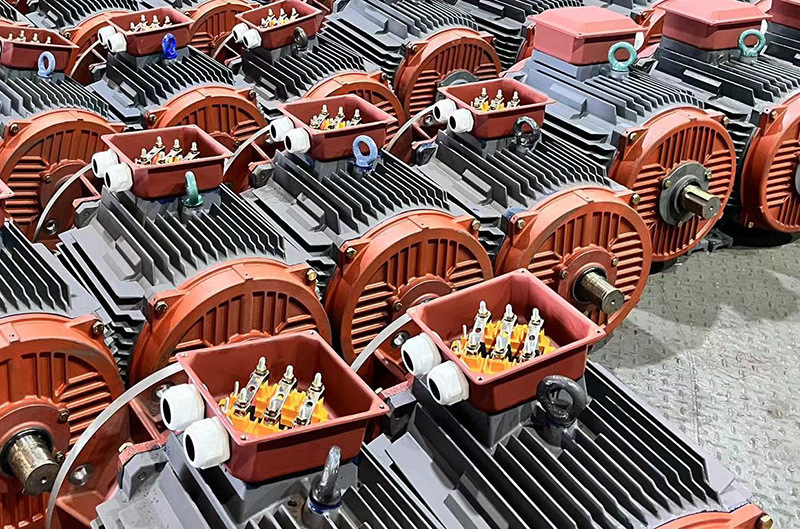
According to the type of power supply, motors can be divided into DC motors and AC motors. In this issue of Motor Encyclopedia, Wannan Motor will briefly introduce DC motors and AC motors and the difference between the two:
DC motor is a motor that can realize the mutual conversion of DC motor and mechanical energy, when mechanical energy is converted into electrical energy. The working principle of the DC generator is the principle that the alternating electromotive force induced in the armature coil is changed into a DC electromotive force when the commutator cooperates with the commutation effect of the brush.
Working principle of DC motor
A ring-shaped permanent magnet is fixed inside the DC motor. The current passes through the coil on the rotor to generate ampere force. When the coil on the rotor is parallel to the magnetic field, the direction of the magnetic field that continues to rotate will change. Therefore, the brush at the end of the rotor is in alternate contact with the conversion sheet, so the direction of the current on the coil also changes, and the direction of the generated Loren magnetic force remains unchanged, so the motor can keep rotating in one direction.
The working principle of the DC generator is the principle that the alternating electromotive force induced in the armature coil is changed into a DC electromotive force when the commutator cooperates with the commutation effect of the brush.
The direction of induced electromotive force is determined according to the right-hand rule (the magnetic induction line points to the palm of the hand, the thumb points to the direction of conductor movement, and the other four fingers point to the direction of induced electromotive force in the conductor).
The direction of the conductor force is determined by the left-hand formula. This pair of electromagnetic forces form a torque acting on the armature. This torque is called electromagnetic torque in a rotating machine. The direction of the torque is counterclockwise, trying to make the armature rotate counterclockwise. If this electromagnetic torque can overcome the resistance torque on the armature (such as the resistance torque caused by friction and other load torques), the armature can rotate in the counter-clockwise direction.
AC motor:
AC motor is used to achieve mechanical energy and alternating current can be converted to each other. Due to the great development of AC power system, AC motor has become the motor in common use. Compared with the DC motor, the AC motor has a simple structure, convenient manufacture, relatively firm, and easy to make into a high-speed, high-voltage, high-current, and large-capacity motor because it does not have a steering gear. AC motor power covers a large range, from a few watts to hundreds of thousands of watts, or even millions of watts.
the difference between dc motor and ac motor:
1. The motor whose speed is proportional to the voltage is a DC motor, and the motor whose speed is proportional to the frequency is called an AC motor.
2. The DC motor is commutated coil by coil, while the AC motor is commutated step by step.
3. DC motor is voltage regulation and speed regulation, while AC motor is variable frequency speed regulation, which is the watershed between DC motor and AC motor.
4. The fundamental difference between DC motor and AC motor is that the potential balance equation is different:
(1), DC motor potential balance equation is: U = C ф n
(2), AC motor potential balance equation is: U = C ф f
(3) The DC motor has fast response, large starting torque, and can provide torque from zero speed to rated speed. However, the advantage of the DC motor is also its disadvantage, because the DC motor needs to produce rated load. For the performance of constant torque, the armature magnetic field and the rotor magnetic field must be maintained at 90 ˚, which is the spark generated by the carbon brush and the commutator when the motor rotates, therefore, in addition to causing damage to the components, the use of toner is also limited. AC motor without carbon brush and commutator, maintenance-free, strong, wide application, but the characteristics to achieve the equivalent of DC motor performance must be achieved with complex control technology. The three-phase asynchronous motor has simple structure, reliable operation and low cost.
recommend News
The difference between DC motor and AC motor
2024-07-29
Share

Wu Dejun: General Manager
Hu Pengbin: Marketing Director
Production site:
No.28, Huaiying Road, Gaoqiao Town, Changsha City, Hunan Province
Zip Code: 410145
Telephone:0731-86156236
ZhenHua Packing Machinery
Online consultation
Leave a message quickly and our experts will contact you
ZhenHua Packing Machinery

SAF Coolest v1.3.1.2 设置面板 GAGSD-ZGYF-JESSE-ZEA
无数据提示
Sorry, the current column is being updated, please look forward to it!
You can view other columns or returnHome Page